Guide to Editing Docs
Hello! As you may be able to notice, this docs site is completely open source and free to edit on GitHub. You can see the GitHub page for this site at https://github.com/EphemeralSpace/docs.
Keep in mind that while web-edit PRs (those made through the GitHub web UI) are not allowed on the main Ephemeral Space Repo, this is not the case here.
Style
Documentation should be written in a technical communications style. Effective technical communications are concise, precise, direct, and well organized and should be written in an appropriate voice and tone using correct mechanics and grammar, citing relevant sources where needed.
Making basic edits
If you just want to make a basic edit of a page, simply follow these steps--you don't need any of the fancy stuff talked about later:
-
Create an account on GitHub, or log in if you already have one.
-
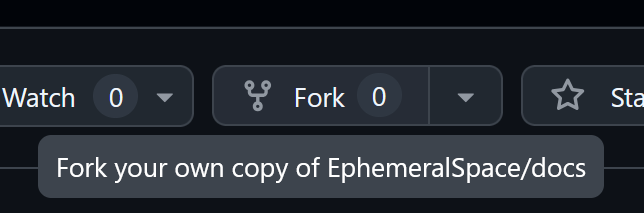
Fork the EphemeralSpace/docs repo on GitHub.
-
Find the file corresponding to the page you want to edit on the documentation repository.
-
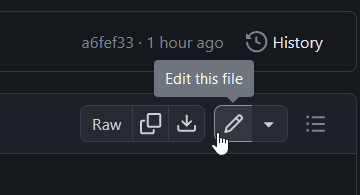
Click the 'Edit this file' button at the top right of the file view.
- Make your changes, then commit & create a pull request! We'll handle the rest.
Building
If you want to locally build the docs, the necessary dependencies are Rust and some binaries installed using cargo. It's recommended that you use cargo install or cargo quickinstall, as building can take a while.
From cargo, install:
mdbook@0.4.51mdbook-pagetoc@0.2.0mdbook-admonish@1.20.0mdbook-linkcheck@0.7.7mdbook-template@1.1.0
Alternatively, this repo supports nix flakes. If you have nix installed, you can run nix develop github:EphemeralSpace/docs to enter a dev shell with all necessary binaries, or just run nix develop in the main directory if you have it cloned.
Run mdbook serve to build and locally host the documentation from the book directory at localhost:3000.
Testing changes
If you've made a PR, the easiest way to test your changes, since they're just markdown, is to view them in GitHub's own markdown viewer in the Files changed tab. You can also use a local markdown previewer extension for something like VSCode.
If you want a slightly more authentic experience, every PR will have the Test mdBook Build & Upload Artifact action run, and you can download the built site like so (it wont be expired if its recent I just didn't want to bother running another action):

Then, just unzip it and open index.html. Our custom CSS and stuff won't work super well but it'll look good enough.
For an authentic-authentic experience, just follow the build instructions above and run mdbook serve like normal.
Review
Maintainers will review pull requests for documentation for content and style. Maintainers understand that many contributors do not speak English as a native language and will be helpful with their review comments.
To help make best use of maintainers' review time, before submitting please:
- Proofread your changes
- Use a spell checker
- Consider using grammar review tools like Grammarly
Organization
When writing design documentation, the folder organization and layout in SUMMARY.md (what shows up in the sidebar) are very important for making things easy to parse.
Here's how things are currently organized in the design section, and how they should ideally stay organized for the future:
- Meta-information about design -- design pillars, tips on how to reason about design, terminology, etc should always be at the top of the section and visually separate from more meaty documentation.
- Core documentation, which will always be relevant irrespective of gamemode and mostly touches on foundational mechanical things like interaction or simulationist elements of the game, should be the next section
- More specific 'feature' documentation, which may consist of describing a mechanic and enumerating the different elements of it like events, secret identities or jobs, should be in a different section and below core mechanical design.
- When ordering within a section, place pages with lots of subpages first, and sort alphabetically after that. Small sections can be ordered in specific ways if it makes sense, but if you can't think of an obvious way, just follow that.
- Subpages of a page should always be in a new folder named after the top-level page. The top-level page should not reside in this folder.
- Pages which should exist but do not should be left unlinked and not created, rather than kept as an empty page or with a 'WIP' marker.
- Avoid creating more layers of nesting than necessary. If you need to delineate two different 'sections' of design, as is done right now, just use a section delineator in the SUMMARY.md layout itself.